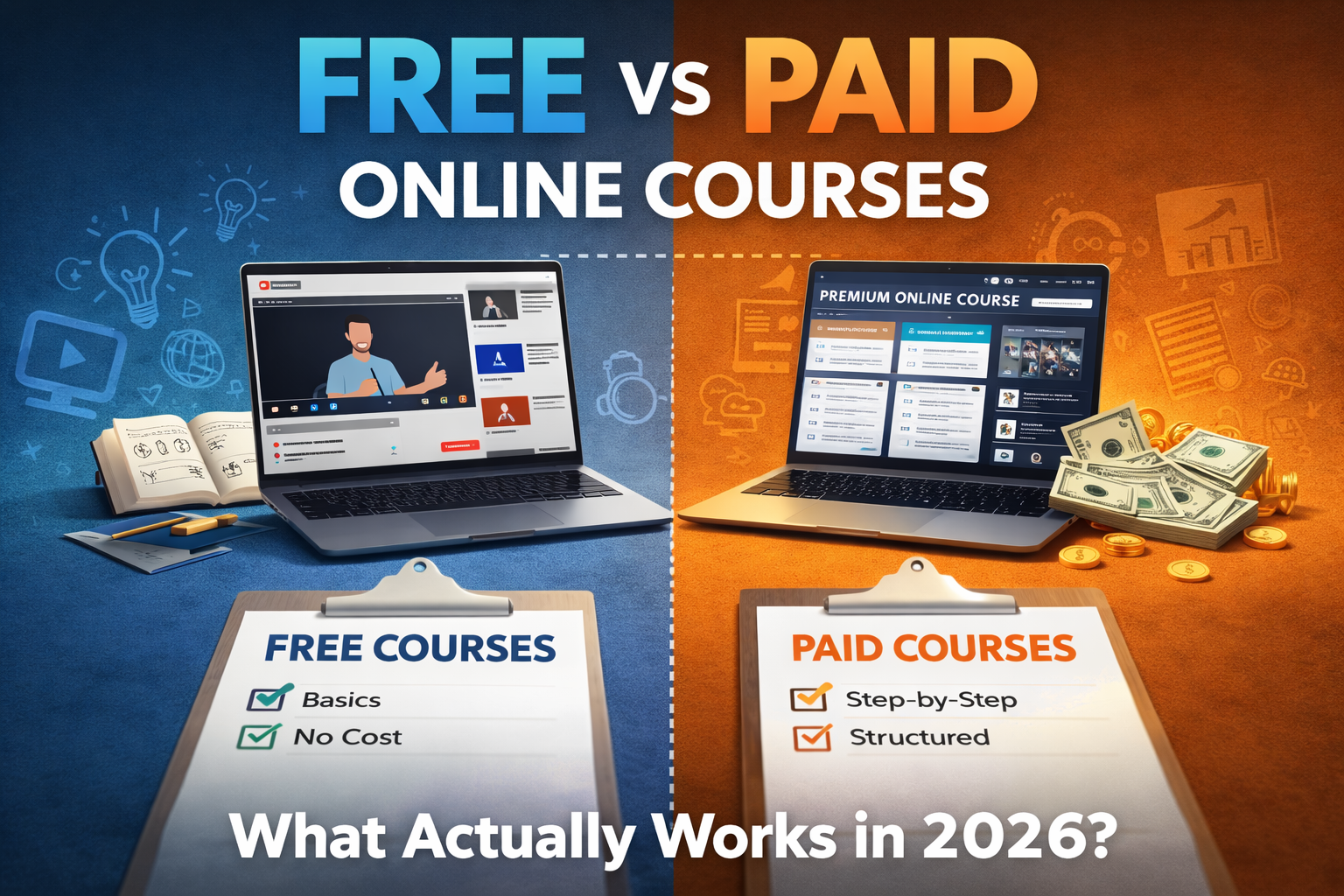
Online education has never been more accessible. In 2026, you can learn almost anything for free — from YouTube tutorials to open university platforms. At the same time, premium online courses often cost hundreds or even thousands of dollars.
So the real question is not “Which is cheaper?” — it’s which one actually works?
This guide breaks down the real differences between free and paid online courses, based on structure, results, accountability, and long-term skill development.
What Free Online Courses Do Well
Free learning platforms have grown significantly over the past decade. They are ideal for exploration and beginner exposure.
- Zero financial risk
- Quick introductions to new topics
- Flexible and self-paced
- Massive variety of subjects
If you are just testing whether you like trading, coding, AI tools, or digital marketing, free content is a smart starting point.
Where Free Courses Often Fall Short
While free resources are valuable, they usually lack one key element: structure.
- No step-by-step roadmap
- No accountability
- Content scattered across multiple videos
- Limited practical frameworks
- Often outdated material
Many learners jump from video to video without building a cohesive skill set. This leads to information overload instead of real mastery.
What Paid Online Courses Offer
Premium courses are designed differently. They are built as complete systems rather than isolated lessons.
- Structured curriculum
- Clear progression path
- Templates and frameworks
- Case studies and real examples
- Often community or support access
The biggest advantage of paid courses is organized implementation. Instead of guessing what to learn next, you follow a roadmap.
Completion Rates: The Hidden Difference
Studies consistently show that free course completion rates are significantly lower than paid ones. When people invest money, they are more likely to finish what they start.
This psychological commitment often makes the difference between “watching content” and actually applying it.
When Free Courses Are Enough
- You are exploring a new interest
- You only need surface-level knowledge
- You are supplementing structured learning
- Your budget is extremely limited
Free education works best as a starting tool — not necessarily as a mastery tool.
When Paid Courses Make More Sense
- You want to build income-producing skills
- You need step-by-step guidance
- You want advanced frameworks
- You value structured progression
- You want faster results
For skills like day trading, SEO, paid advertising, AI automation, or business building, structured systems often accelerate learning significantly.
Free vs Paid: A Direct Comparison
| Factor | Free Courses | Paid Courses |
|---|---|---|
| Cost | $0 | $50 – $2000+ |
| Structure | Often scattered | Step-by-step curriculum |
| Depth | Basic to intermediate | Beginner to advanced systems |
| Accountability | Low | Higher commitment |
| Speed of Learning | Slower (trial & error) | Faster (guided) |
So, What Actually Works in 2026?
The most effective approach is hybrid learning:
- Start with free content to understand fundamentals.
- Move to structured paid programs when you’re serious about mastery.
- Implement consistently.
The format itself is not magic — implementation is.
Final Thoughts
Free online courses are powerful entry points. Paid online courses provide structure and acceleration. The real difference is not price — it’s commitment and organization.
In 2026, learners who treat education as an investment — not entertainment — see the strongest results.